Monday, August 5, 2013

5日 快晴でとても暑い日でした


昨日に続き、今日も快晴でした。
日差しが強く日焼けで真っ黒になってきました。
発掘区はオホーツク文化の魚骨層に突入し、小さい魚の骨片やクジラの骨が土器に混じって出土するようになってきました。

Like yesterday, it was fine weather today.
I got sunburned and became dark.
It arrived at the fish bone layer of the Okhotsk culture, and pottery, fish bone and whale bone came to be excavated.


お昼には調査に参加されているカリフォルニア大の羽生先生によるレクチャーがありました。
日本の縄文時代についてのお話でした。
これもフィールドスクールならではの光景です。

After lunch,  there was a lecture by Prof. Habu of Univ. of California participated in our excavation.
It was a story about the Jomon period in Japan.

Sunday, August 4, 2013

4日 浜中2遺跡発掘調査説明会・体験発掘

今日は、午前と午後に一回ずつ、浜中2遺跡発掘調査説明会および体験発掘プログラムを行いました。
快晴で強い日差しがさしていましたが、33人の町民の方が参加してくれました。
まず、浜中2遺跡の説明をしてから、さっそく体験発掘!


ん?何か見つけたかな?


ふるいの説明を聞く参加者のみなさま。


こどもたちも真剣に掘り進めます。
沢山の動物の骨を見つけてくれました!


体験発掘がおわったあとも、出土した動物の骨について質問してくれた未来の考古学者。
また遺跡に遊びに来てくださいね。


Saturday, August 3, 2013

3日 日本文化体験デー

今日は、発掘調査はお休み。
礼文町教育委員会の御皆様のご厚意で、海外から来た学生のための日本文化体験イベントがありました。

Today, we got a day off.
Instead of standing on the site, we enjoyed the traditional cultural event.

まずは、礼文太鼓保存会の皆様による礼文太鼓の演奏。
Society of Protecting Rebun Taiko drum played several tunes.


その後、けん玉体験と礼文太鼓体験をしました。
After the performance, the foreign students tried to play Kendama, a traditional toy and 
Rebun Taiko druming.


想像以上に難しいけん玉に、四苦八苦の学生たち・・・
コツをつかもうと一生懸命です。
Kendama, it was super difficult to be handled more than their expectation!
Kendama teacher taught them kindly several techniques of it.


法被を着て、いざ叩かん!
でもリズムが難しい!先生の手拍子に併せて、礼文太鼓の基本的な打ち方を練習中。
Wearing uniform, they bust into playing....
But it is super hard to get rhythm of beating as well.
Finally, they successfully managed to play the first part of Rebun Taiko tune.  


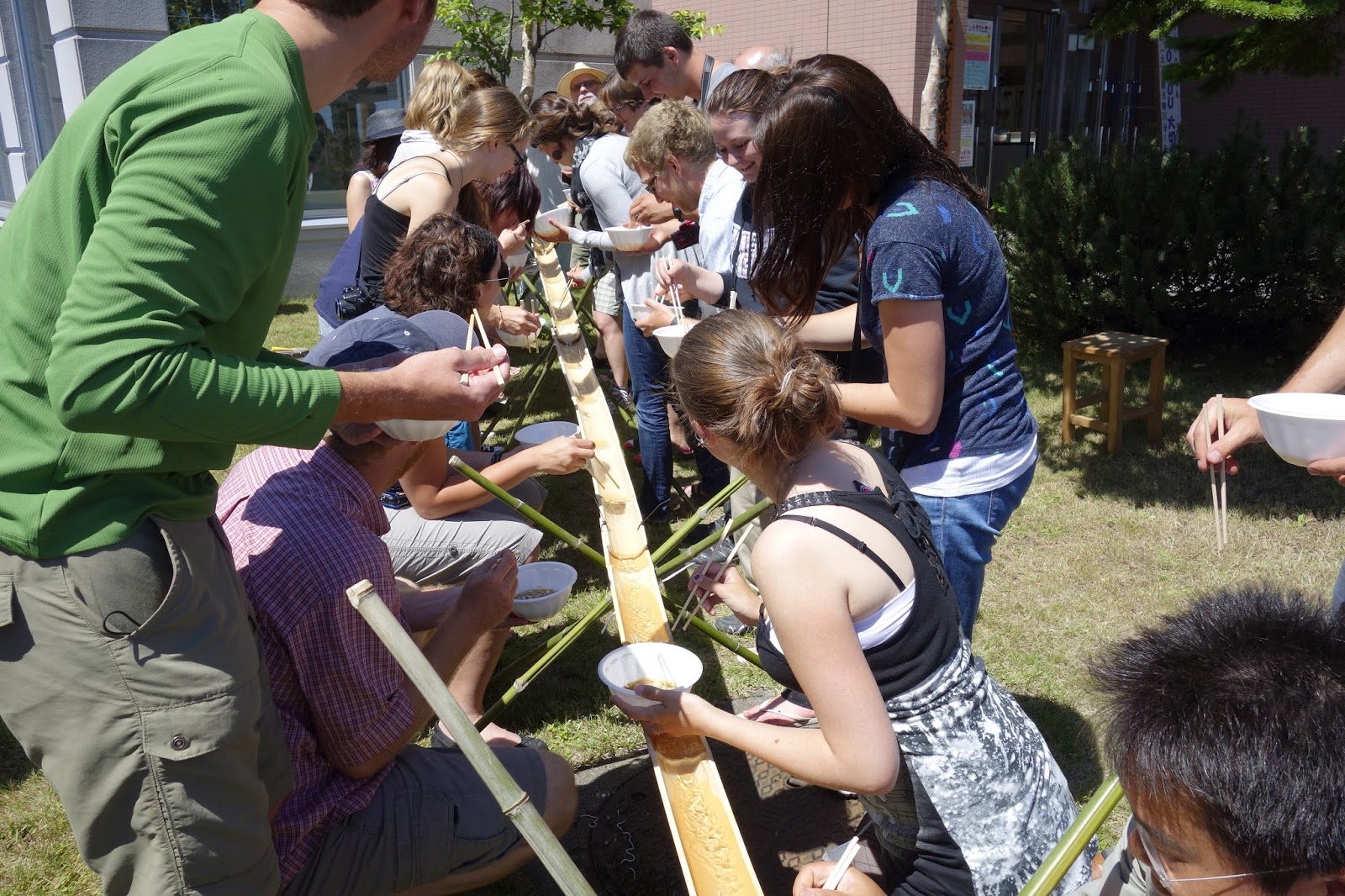
本日のランチは、流しそうめん!
日本の夏の風物詩です。
学生たちは、上手にお箸を使ってそうめんを取ろうと奮闘中。
Today's lunch, we had Nagashi-Somen,fine white noodles served flowing in a small bamboo flume.
It reminds Japanese of summer.
Everyone was trying to catch noodle with chopsticks as well as they can.


新聞記事2


2013年7月31日北海道新聞[日刊]


2013年8月3日日刊宗谷新聞

Thursday, August 1, 2013

1日 8月になったけれども・・・ Strong wind day…


8月になったけれども、今日の現場は強風が吹きつけ、ちょっと寒いと感じてしまうほどでした。
昨日までに引き続き、どんどん掘り進んでいます。
地表から40cmほど掘り進めた砂層からは少しづつ動物の骨が出土するようになりました。

It is August from today, but it was strong wind blowing at the site today, would feel to be a little cold.
We are digging steadily.
Animal bone came to be excavated from the approximately 40cm sand layer from surface.


これは恐らくニホンアシカの下顎骨と頚椎の骨かと・・・。
ニホンアシカは今ではもう絶滅したといわれているので、いわば絶滅動物の骨(!?)を発掘したことになります。
このような大型の骨が出土すると、現場では歓声があがります。

This is bone of Japanese sea lion.
Japanese sea lion already became extinct now, so to speak, we find the bone of the extinction animal.
When such a large bone is excavated, a shout of joy breaks out on the site.

1日 整理作業の一コマ

出土遺物の整理作業は、全て上泊小学校で行っています。 
カナダの学生は、2日毎に交代で整理作業に携わります。

発掘調査が本格化し、出土する遺物の数も増えてきて、学生が行う作業も複雑になってきました。

最初の関門は、注記!
面相筆で、小さい文字を小さい土器に書くのは至難の業・・・
おもわず、虫眼鏡を使う学生も。


また、土器を洗いはじめて、学生さんたちが徐々に土器について興味を持ち始めました。
なので本日は急遽、油粘土に様々な道具を使って、文様をつけるミニワークショップを開催。
縄文だけでなく、沈線文、刻文、貼付文・・・とみなさん真剣に文様をつけていました。


1日 Fingertip works lead to Big discovery


 Today, the team of Alex, Ben, Robyn, Graeme and myself (Tyler) worked in the lab.   
The lab is actually an old, abandoned school, which has been utilized for cleaning, sorting and examining artifacts.  We have even dedicated a section of the gym for lectures, and presentations.  

  This was our second day in the lab and we spent most of our time cleaning and organizing artifacts.  Unfortunately, most of the material was from a wall collapse on site (A04 into A03).  On the bright side, although the material is out of context, there are a lot of great artifacts.  We were able to get our hands on large pieces of obsidian, a pig mandible, flakes of agate, and several other interesting artifacts that would normally not be in such a high concentration. 


  The floatation machine, which has been an ongoing choir to get operational, was finally fixed today thanks to Erin and Victoria`s hard work.

 We also had students from Yuho high school join us in the lab today.  This was their third and final day visiting the Hamanaka II site.  Although they were incredibly shy at first, it was great showing them the artifacts and having them engage and ask questions and in turn, begin to open up.  My team in the lab, and the entire crew at Hamanaka II are very grateful for their visit.